Guided self-assessment
8 home tests adapted from the USTA protocol, with a timer, plus your rating of each stroke. You see your strengths, your asymmetries and what to prioritize.
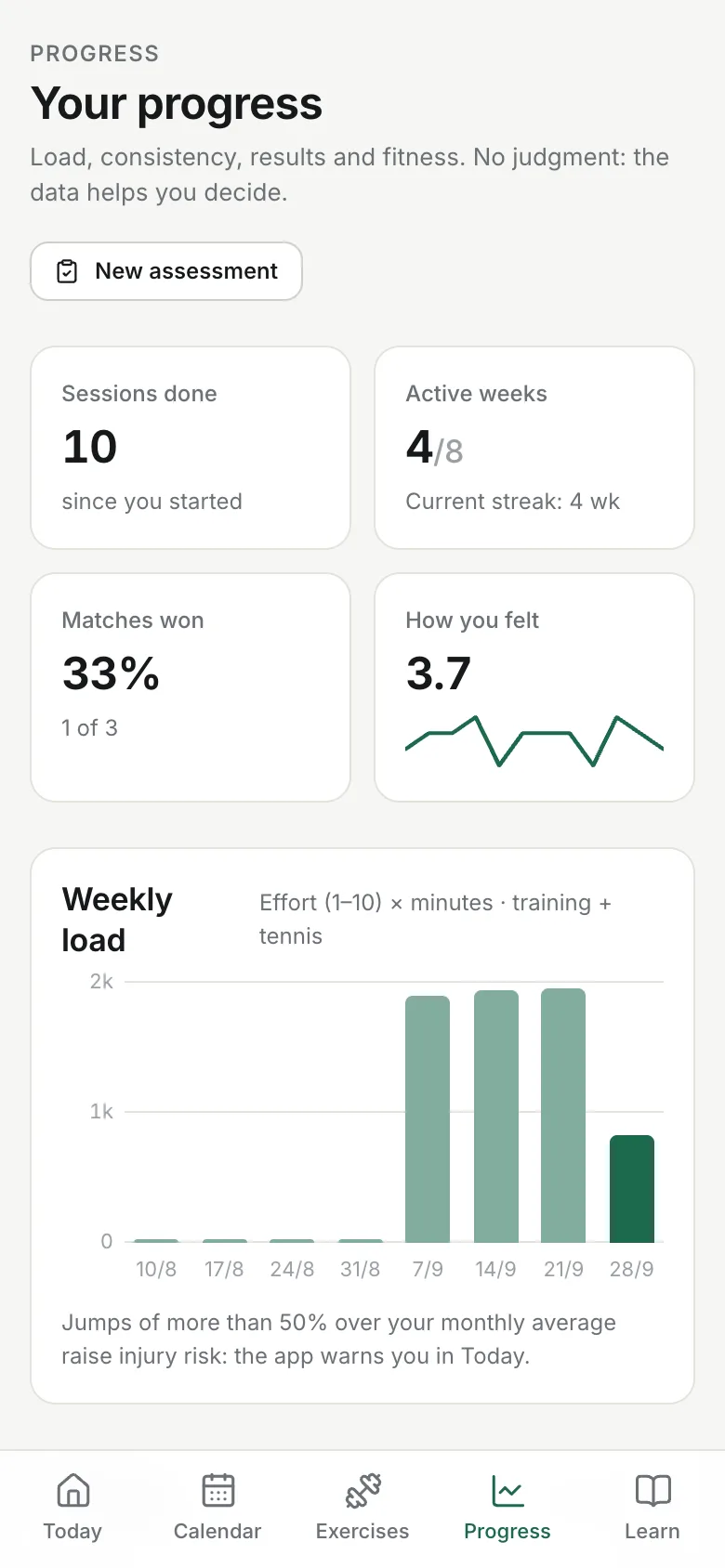
For amateur tennis players who compete
Mi Tenis builds your plan around your level, your discomfort and your match schedule, and supports you before and after every match: it helps you set a game intention, reflect on how you played and suggests what to try next time.
Free · No sign-up · No ads · Works offline
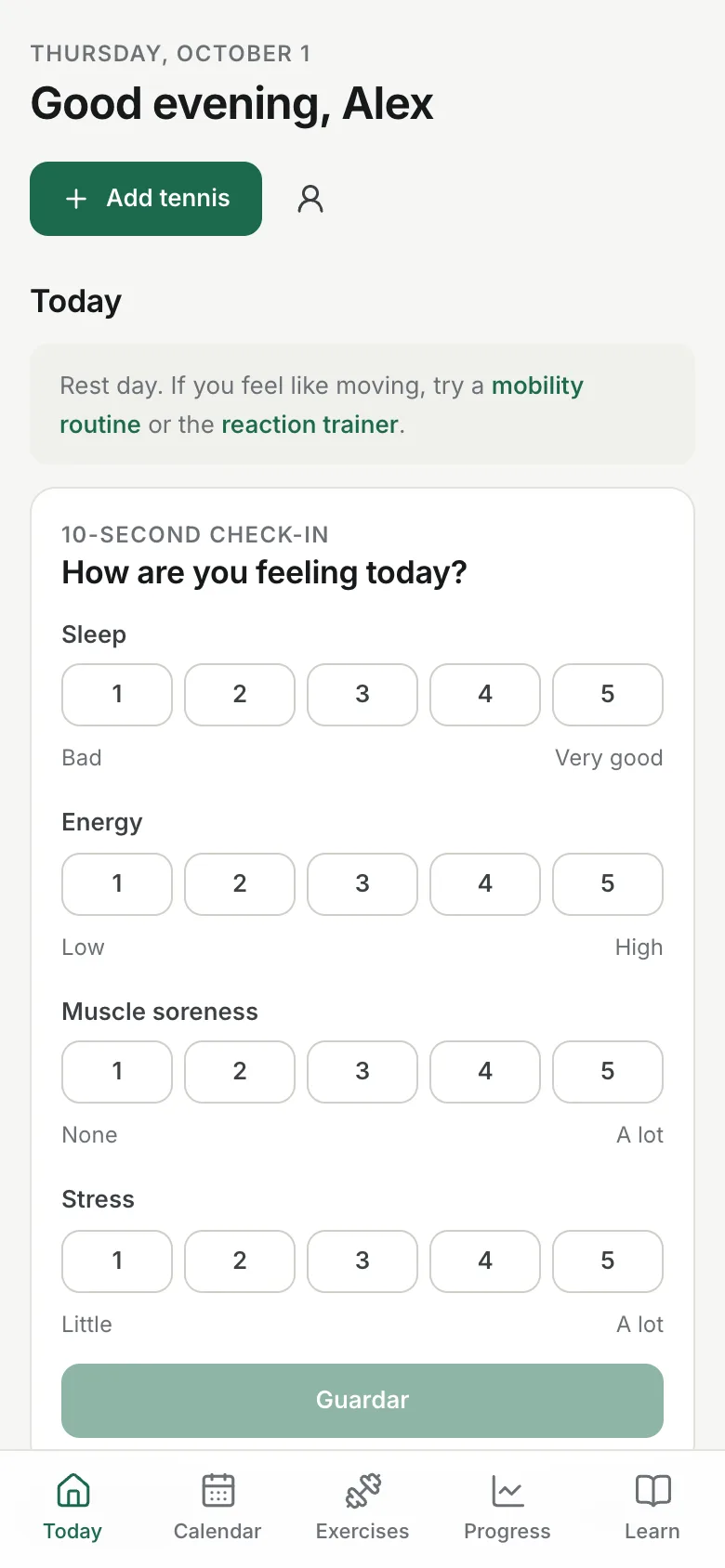
The problem
There are almost no clear, complete guides for the amateur player. What you find are single-exercise videos, generic gym routines or hundred-page technical books written for coaches. Nobody tells you what to do this week, with what you have at home and around your matches.
Mi Tenis is a fitness training app for amateur tennis players. It assesses your fitness and your game, generates a weekly routine with machine-free home exercises, adapts it to your discomfort and your matches, and helps you analyze your opponents to improve your tactics.
Features
8 home tests adapted from the USTA protocol, with a timer, plus your rating of each stroke. You see your strengths, your asymmetries and what to prioritize.
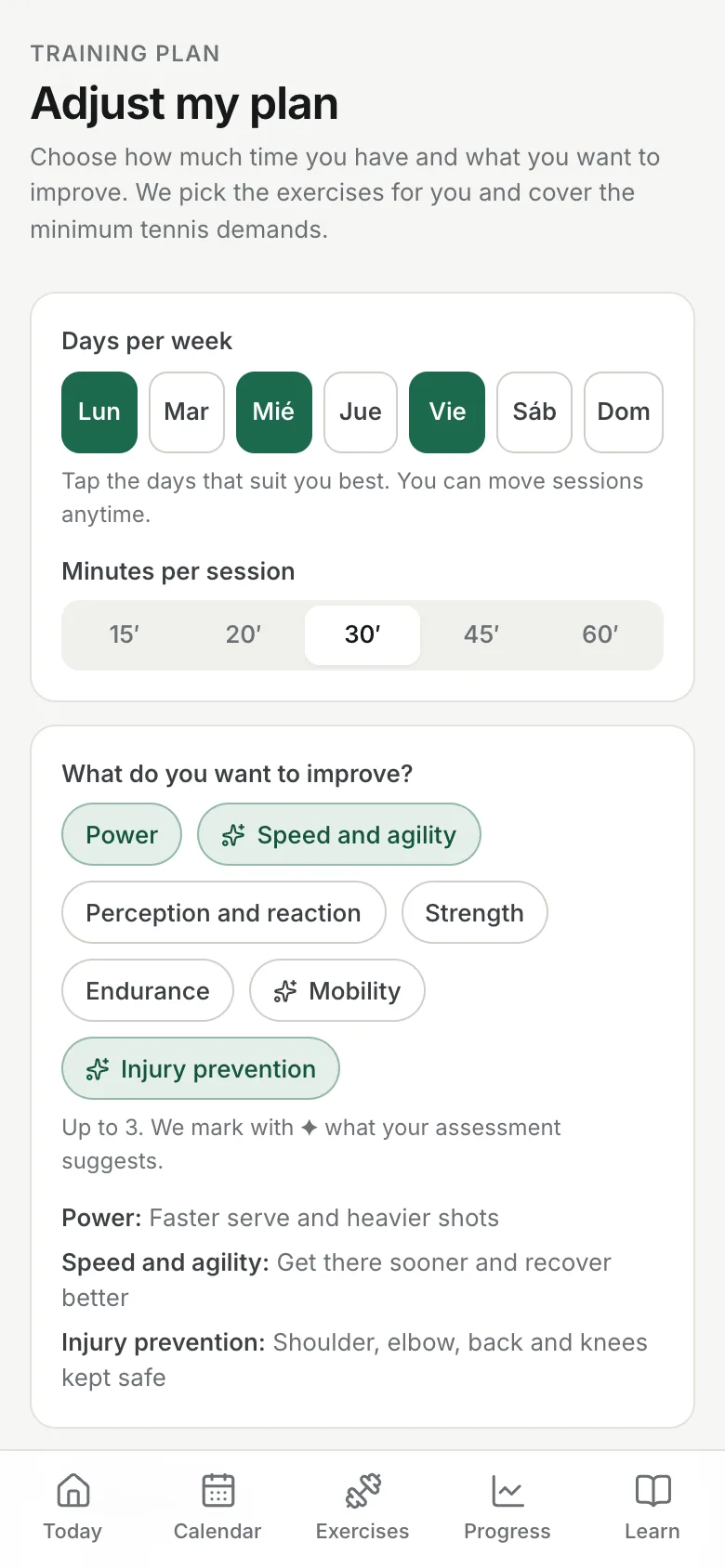
Choose days, minutes and up to 3 goals out of 7 (power, speed and agility, perception and reaction, strength, endurance, mobility, injury prevention). The app picks the exercises and covers the 13 groups tennis demands every week.
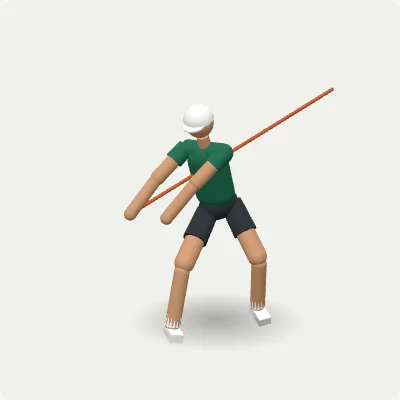
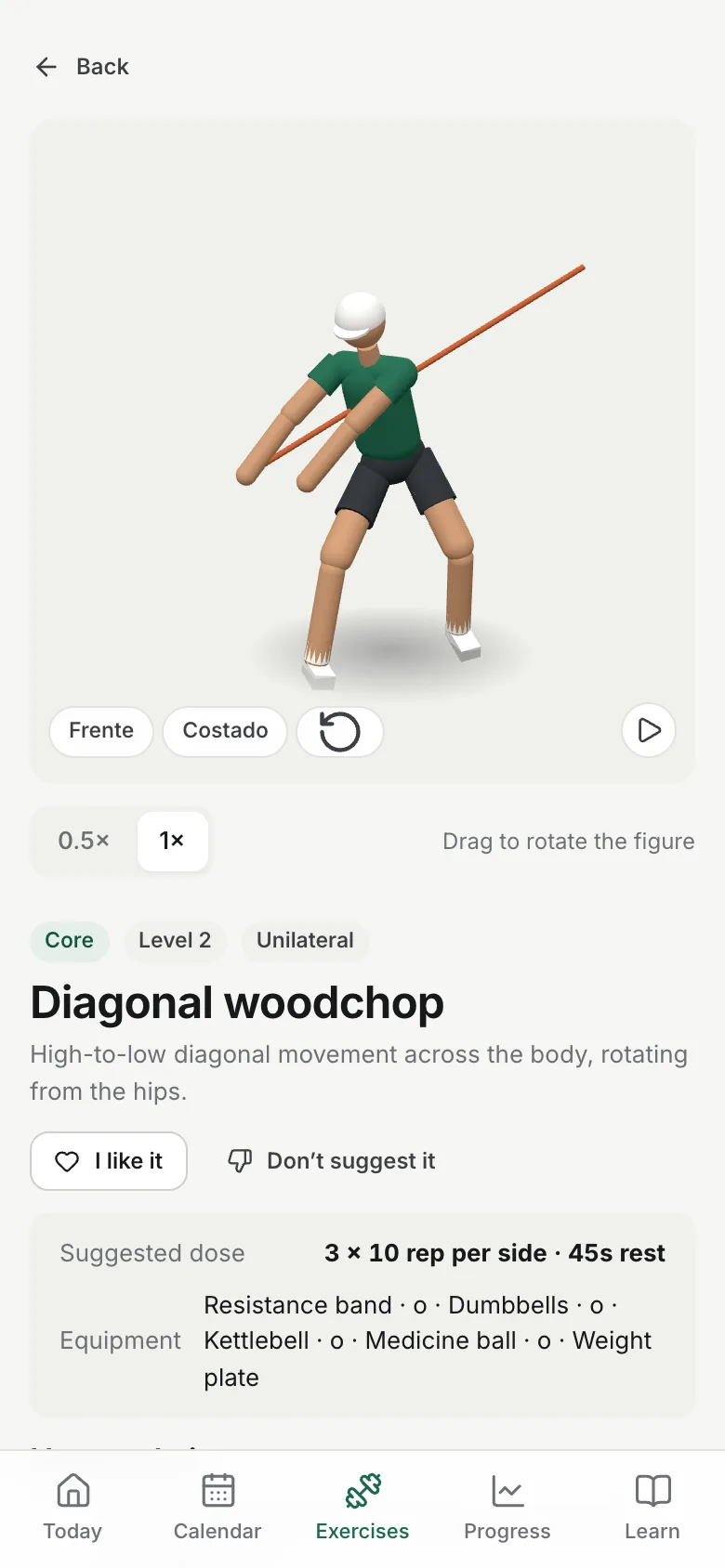
111 machine-free exercises with a 3D figure you can rotate, clear steps, key points and common mistakes to keep you injury-free.
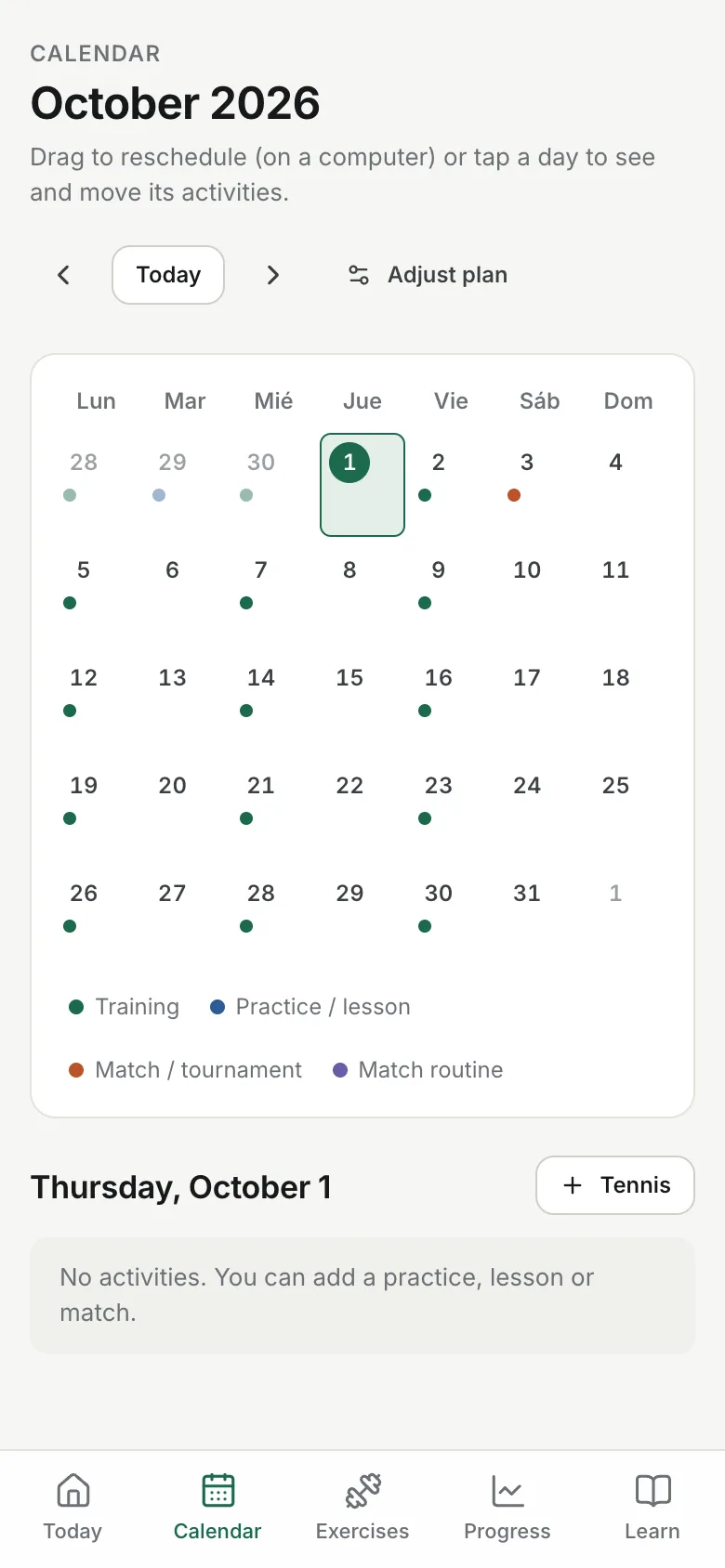
Your tennis planner: practices, lessons, matches, tournaments and workouts in one place. Move, shorten or skip sessions with one tap; the day before a match the session lightens automatically.
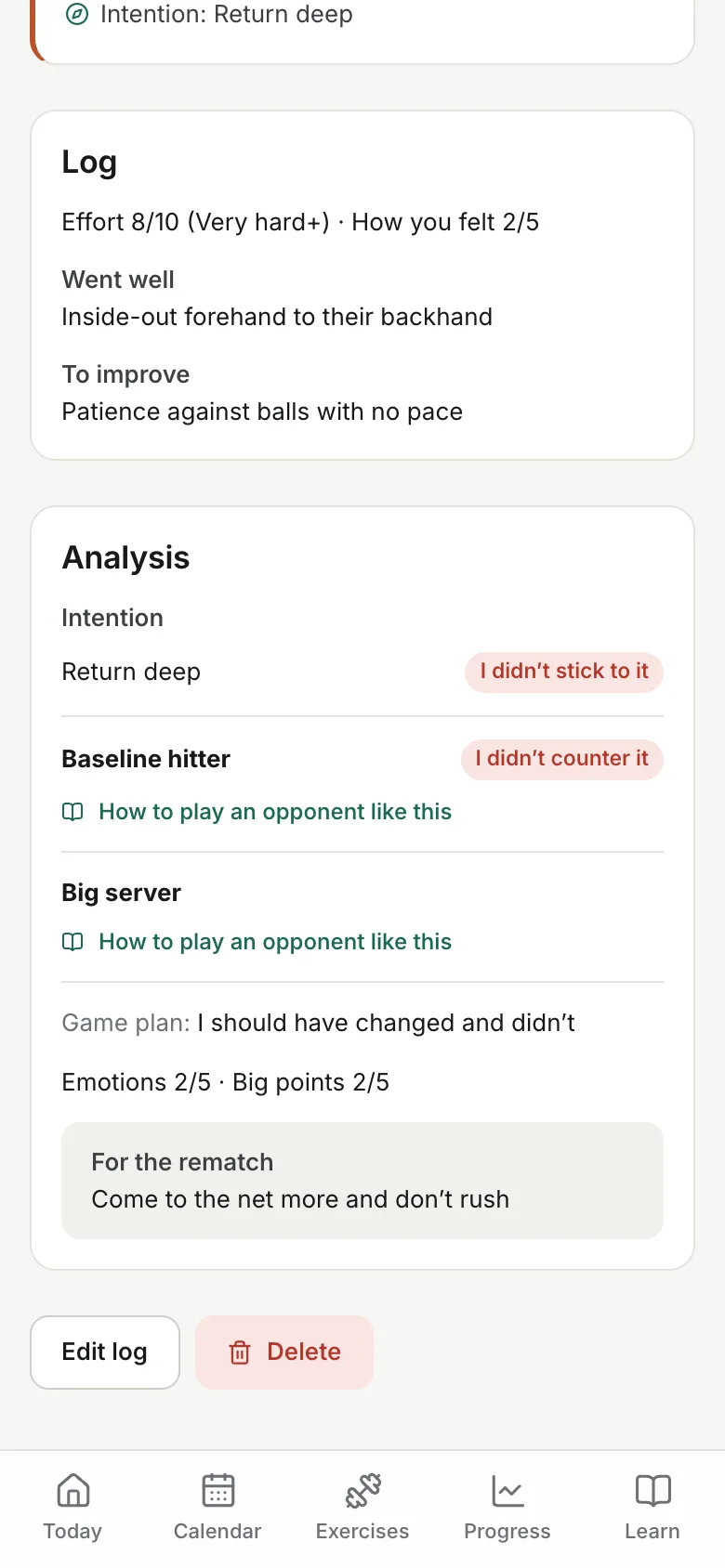
Go on court with an intention (be aggressive, come to the net, keep the ball in, mix it up…), mark how your opponent played (20 traits) and reflect: did you stick to it? Did you counter them? Your note is saved for the rematch.
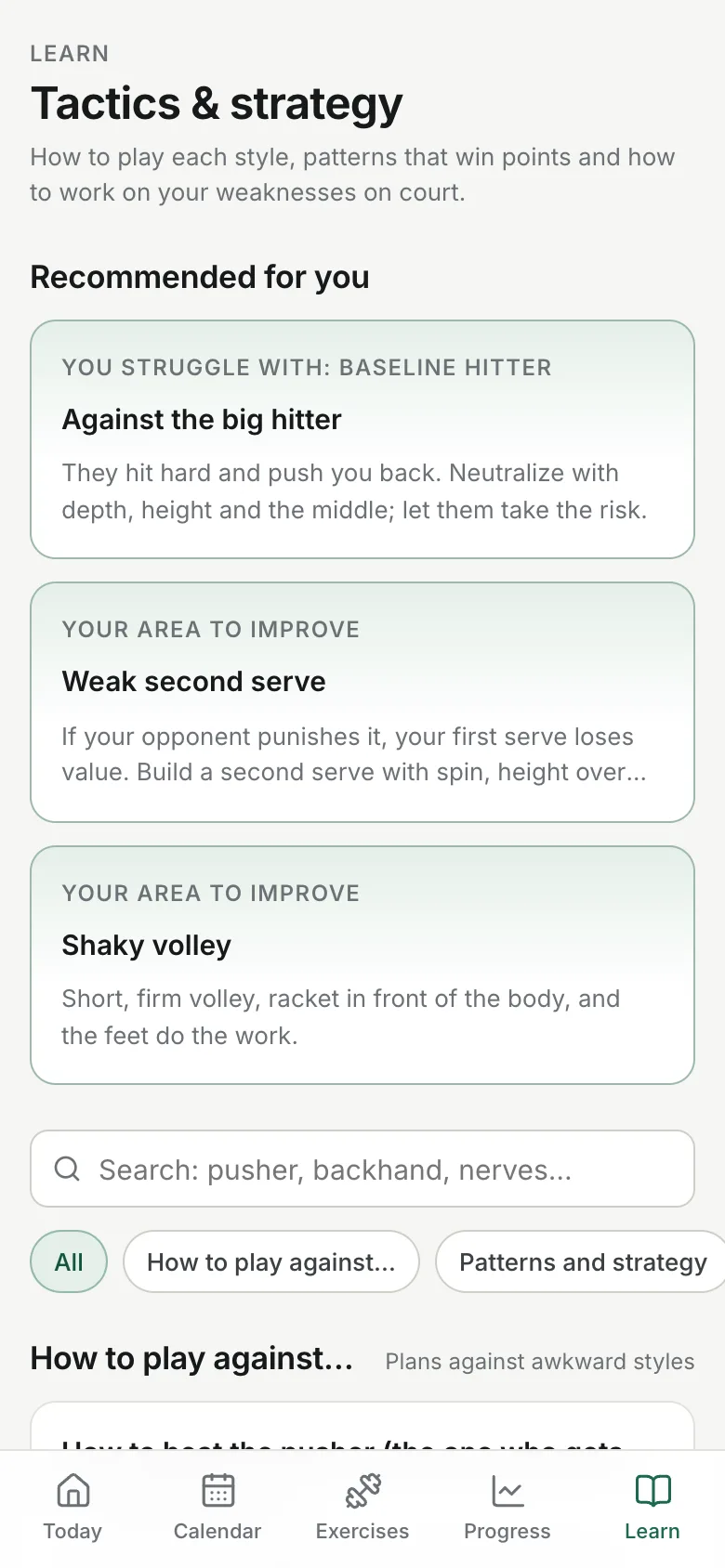
29 guides: how to play every type of opponent, point-winning patterns, the points that count double and how to fix your weaknesses, with on-court drills.
Your tennis planner
Mi Tenis isn’t just an exercise routine: it’s your tennis planner and a space to think about your game. It suggests, asks and recommends, so every match leaves you with something.
Add the match next to your practices and workouts. The session the day before lightens automatically and we suggest going out with a clear intention: be aggressive, come to the net, keep the ball in, mix it up, be patient… If you already know how your opponent plays, we suggest which one; if you’ve played them before, we show your history and your rematch note.
A 12-minute pre-match warm-up, standing and court-friendly, and a cool-down when you finish.
Did you stick to your intention? Did you do anything to counter what your opponent was doing? Did you have a plan and adapt it? How did you handle emotions and the big points? No right answers: it’s so you show up with a plan next time.
Try it here
Drag the figure to rotate it. This is how every exercise looks in the app.
How it works
Your details, your level, your equipment and anything that bothers you. Three minutes.
8 simple home tests and your rating of each stroke. You know where to start.
15 to 60-minute sessions in your calendar, alongside your practices and matches.
Built for real life
No punishing streaks. We count active weeks and you get one grace week per month.
Every exercise declares which area it loads; if something hurts, it won’t suggest it.
Lightweight animations that work offline and can be paused, slowed down and rotated.
Shoulder, elbow, ankle, rotation and explosiveness: what tennis demands and other fitness apps forget.
Everything available from day one, with no ads or mandatory accounts.
Guided reflection after you play and a note for the rematch.
Library
Tactics
They get everything back without risk and wait for your mistake. The key: patience, pulling them out of their comfort zone and not giving away points.
High, deep balls that bounce at shoulder height. You have to take time away from them, not accept the awkward shot.
They hit hard and push you back. Neutralize with depth, height and the middle; let them take the risk.
You don’t need to break them often: once is enough. Improve your return, stay calm and take advantage of their second serves.
Watch the ball (not the opponent), return low and soft to their feet, crosscourt, and use the lob so they can’t crowd the net.
Their wide serve on the ad side pulls you off the court right on the big points. Shift your return position openly.
Don’t make them run: they love it. Play deep to the middle, at their body, and open the angle only when you have a clear ball.
They give you low, slow, odd balls. Bend your knees, be patient with the low ball and attack when it rises.
If there’s no obvious weakness, win through consistency in your plan, your first-serve percentage and the big points.
Frequently asked questions
No. All 111 exercises fit in 2×2 meters using your bodyweight or simple gear: dumbbells, kettlebell, plates, resistance bands, medicine ball, a chair or a wall. The app only suggests what you can do with what you have.
It’s free. No ads, no paywalls and no mandatory sign-up: open the app and start.
Yes. You mark the area and how bad it is; the app excludes exercises that load it and adds specific prevention work (for example, wrist eccentrics for tennis elbow). If the pain is strong or persists, see a professional.
From your available days, minutes per session, up to 3 goals (power, speed and agility, perception and reaction, strength, endurance, mobility, injury prevention) and your self-assessment. Every week guarantees 13 minimum work groups for tennis and progresses in 4-week blocks with one deload week.
Move the session with one tap, do the 15-minute short version, lighten it or skip it guilt-free. If you add a match, the session the day before lightens automatically.
Yes. It’s a web app you install on your phone’s home screen and it works offline. You can also use it on a computer.
For amateur players who compete or want to: from people who play with friends to sanctioned tournaments. The self-assessment estimates your level (NTRP scale) and adjusts the difficulty.
It’s hard to find one: the internet is full of standalone exercises and generic gym routines, and the complete information lives in technical books written for coaches. Mi Tenis takes those reference books (USTA, Le Deuff, Steinhöfel, Gilbert) and turns them into a concrete weekly plan tailored to you.
It works as your tennis planner. Before a match it asks you to set a game intention (be aggressive, come to the net, keep the ball in, mix it up, be patient…), suggests one based on how your opponent plays and reminds you of your rematch note if you’ve played them before. Afterwards it guides your reflection: whether you stuck to your intention, whether you countered what your opponent did, how you handled emotions and the big points. Over time you see which opponent types give you the most trouble and how much you win when you stick to your plan.
Spanish, English and Portuguese. It’s picked automatically from your browser language and you can change it anytime.
On your device. You can export it and move it to another device whenever you want.
Build your plan in three minutes. Free, no sign-up.